Fighting Cancer

From a Complex Problem to a Dizzying Discovery: A New Method for Finding Cosmic Lighthouses

A Weizmann Institute algorithm helps discover pulsars – rapidly spinning stars  that can serve as cosmic lighthouses for space navigation and natural laboratories for testing Einstein’s theory of relativity

From A Complex Problem To A Dizzying Discovery 3
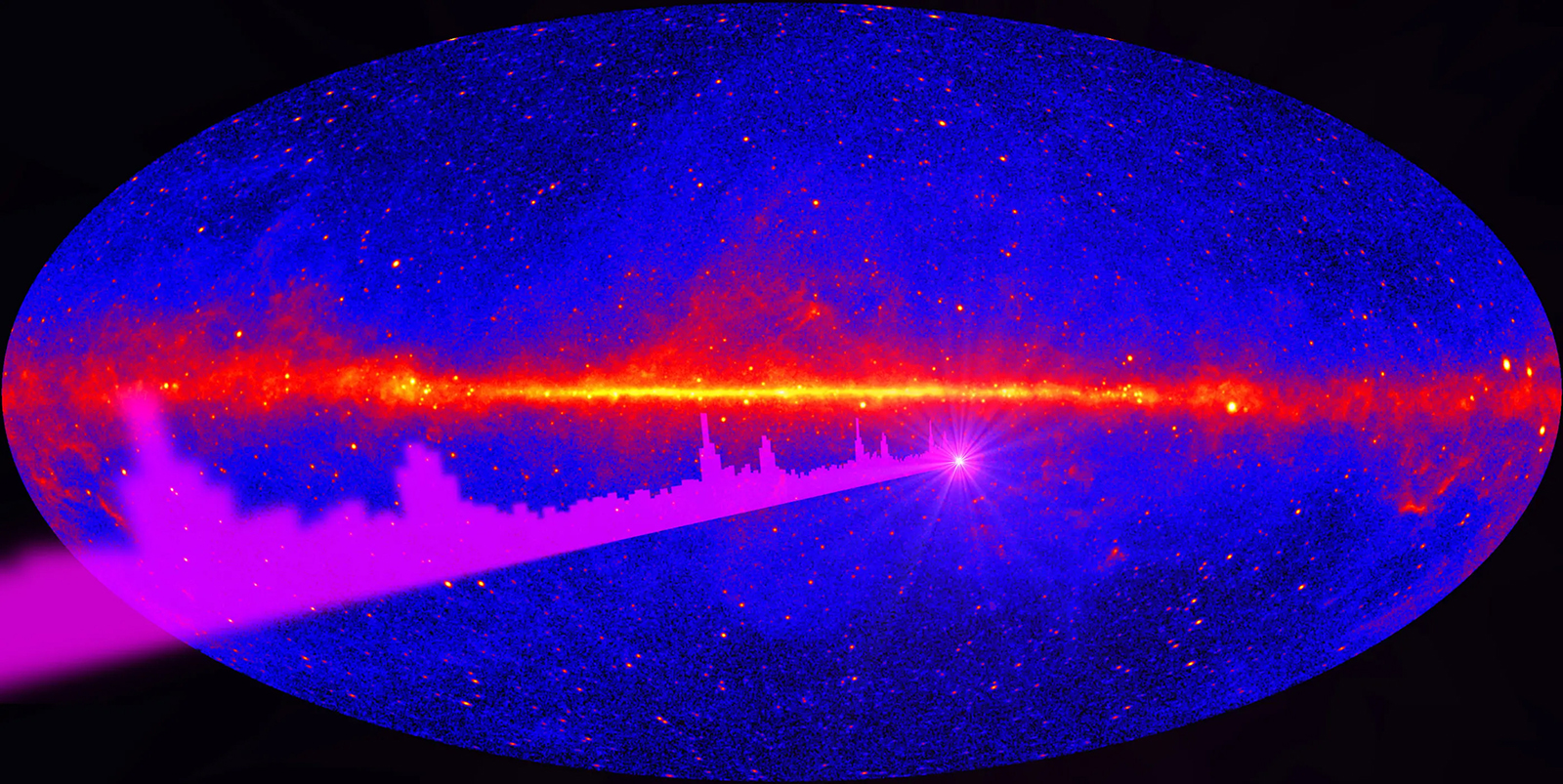
Artist’s impression of gamma-ray pulses (pink) from the newly discovered pulsar PSR J1622-7204, shown at its actual position in the sky but artificially brightened for visibility. The background map, based on 15 years of observations by NASA’s Fermi space telescope, shows gamma-ray emission across the entire sky, with the bright horizontal band marking the plane of our galaxy, the Milky Way. Credit: B. Knispel, Max Planck Institute for Gravitational Physics; NASA/DOE/Fermi LAT Collaboration.

REHOVOT, ISRAEL — November 19, 2026 — A newly discovered star in the southern sky spins at the dizzying rate of more than 260 rotations per second, sending regular pulses of energy toward Earth. Stars of this kind, known as pulsars, provide ideal environments for studying general relativity and gravitational waves, and they can even be used for space navigation. Yet finding pulsars in the vastness of the universe is such a computationally demanding task that a previous attempt to detect this particular pulsar failed despite having taken up computing time equivalent to 600 years on a single processor core. 

Now, researchers at the Weizmann Institute of Science have developed a new algorithm that has enabled them, and their collaborators at the Max Planck Institute for Gravitational Physics in Hannover, Germany, and Chalmers University of Technology in Gothenburg, Sweden, to accomplish the task in just 100 minutes. The discovery of the pulsar – named PSR J1622-7204 – is described in a paper published today in Physical Review Letters, and the new method is already being used to discover additional pulsars.
From A Complex Problem To A Dizzying Discovery 1
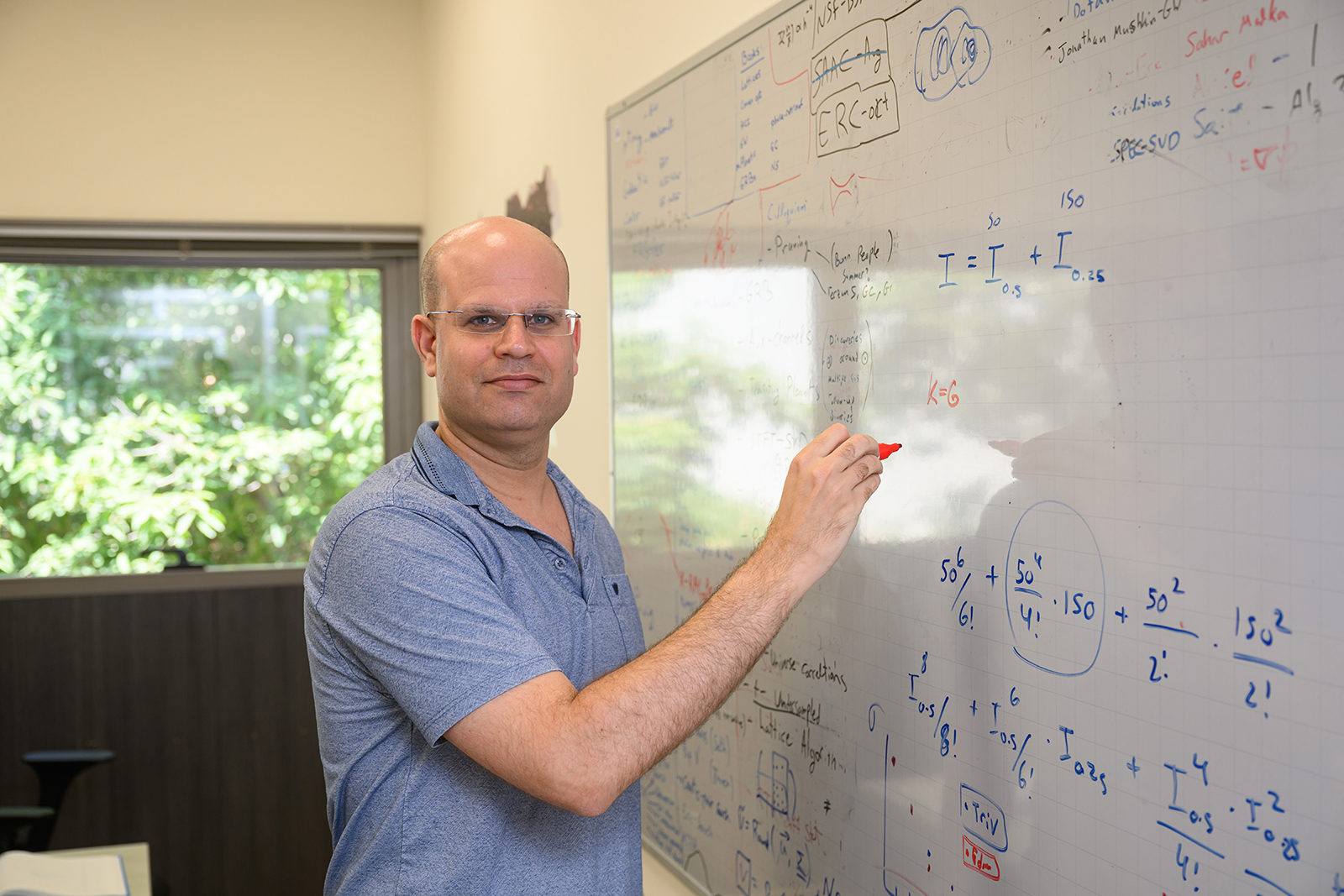
Dr. Barak Zackay

When stars with masses between eight and 20 times that of our Sun run out of their nuclear fuel, they collapse inward and may become pulsars – rapidly rotating, ultra-dense neutron stars. Pulsars generate magnetic fields trillions of times stronger than that of Earth. These fields accelerate charged particles and produce powerful beams of radiation. As the pulsar rotates, its beam sweeps across the sky, pointing toward Earth for only a brief instant during each rotation. As a result, it appears from Earth that the star is emitting energy in regular pulses. Because pulsars continuously lose energy throughout their lifetimes, their rotation gradually slows as they age, and the rate of their pulses decreases.

The first pulsar, discovered in 1967, emitted radio waves, as did nearly all pulsars discovered during the following four decades. In 2008, the launch of NASA’s Fermi Gamma-ray Space Telescope, which detects high-energy radiation, opened new possibilities. In its 18 years of operation, Fermi has identified almost 1,000 regions of the sky emitting gamma rays with characteristics typical of pulsars. Yet conclusively identifying a pulsar remains a complicated task. To do so, astronomers must find a combination of the exact position in the sky and rotational properties – such as rotation rate and its gradual slowdown over time – that matches the observed pulse pattern.

“Trying to find the correct combination among all possibilities without a smart strategy forces us to test an astronomical number of guesses,” explains Dr. Barak Zackay of Weizmann’s Particle Physics and Astrophysics Department. “Another challenge is that although a pulse of energy reaches Earth with every rotation of a pulsar, the Fermi telescope only manages to detect a single packet of energy – a photon – roughly once every 100 million rotations. In addition, the telescope itself is moving, orbiting Earth as Earth circles the Sun. All these factors make the computation required to find a pulsar extremely demanding.”

A geometric solution to a physics problem

In 2025, Zackay’s research group demonstrated that the search for pulsars could be radically simplified. Their approach is based on the premise that each detected pulse marks the completion of a full rotation of the pulsar and its return to the orientation in which its radiation is directed toward Earth. However, as noted, Fermi captures only a tiny fraction of the pulses, leaving unknown the number of full rotations completed between observations. If that information were available, scientists could directly calculate the star’s rotation rate and determine its other properties.

The algorithm developed by the Weizmann researchers aims to supply this missing information.

The researchers realized that each possible guess – which corresponds to a sequence of whole-number rotations – can be represented as a point in a geometric structure known as a lattice. To visualize a lattice, imagine standing at the bottom-left corner of a grid and being allowed to move only in whole-number steps upward and to the right. Every intersection on the grid represents a particular combination of upward and rightward steps – in other words, a set of integers.

"Estimates suggest that hundreds of such pulsars are waiting to be discovered.”

Scientists feed the arrival times of several dozen photons, suspected to be pulses from an unidentified pulsar, into the new algorithm. Based on these measurements, the algorithm constructs a lattice in which each point represents a hypothesis as to the number of rotations the pulsar completed between observations. Each set of rotation counts corresponds to a star with a specific rotational frequency. If the hypothesis is incorrect, calculating the number of rotations completed between observations using that frequency yields non-integer values.

The Weizmann algorithm searches for a solution that minimizes such non-integer deviations, a task known in mathematics as the shortest vector problem. The advantage of reframing the physics problem as a geometric one is that the lattice structure allows previous hypotheses to be added and subtracted, thereby rapidly generating new potential solutions. Although the problem remains computationally difficult, efficient algorithms have been developed for solving it, and the Weizmann algorithm is an adaptation of the most powerful among them.

A new lighthouse in the southern universe

Late last year, scientists from Zackay’s laboratory and from the research group of Prof. Bruce Allen at the Max Planck Institute in Hannover began applying the new method to search for pulsars in promising regions of the sky.

“We found the PSR J1622-7204 in a very short time,” says Zackay. “We ran the new algorithm 20 times, each time using a slightly different set of 80 photons that we suspected originated from the same pulsar, and one of those runs produced the right answer. Each run took just five minutes on a single CPU core, allowing us to determine the star’s properties in less than two hours. We were somewhat lucky, however, since theoretical calculations showed it should take 300 runs to achieve a 95 percent probability of success.”

From A Complex Problem To A Dizzying Discovery 2 (1)
Dotan Gazith

“We were able to calculate the pulsar’s rotation rate with great precision and determine the rate at which it slows over time,” says Dotan Gazith of Zackay’s lab, who led the study together with Dr. Daniel Pook-Kolb from Allen’s group. “Our calculations show that in about 100 million years, the star will complete roughly five fewer rotations per second than it does today. We have since expanded the search, and we are already discovering additional pulsars using this new method.”

Pulsars are sometimes referred to as lighthouses of the universe. A NASA experiment conducted in 2018 showed that a spacecraft can determine its position in space to within a few kilometers by measuring the arrival times of pulses from different pulsars. The discovery of extremely fast pulsars – those that rotate hundreds of times per second – is particularly important because they can serve as the basis for extraordinarily precise clocks. Research groups around the world are working to develop such clocks not only for navigation, but also because deviations in their timing could reveal effects predicted by Einstein’s general theory of relativity, formulated more than a century ago.

The central principle of general relativity is that the universe has four dimensions – length, width, height and time – and that massive objects warp the spacetime around them. Like a stone thrown into a lake, accelerating masses generate ripples in spacetime – known as gravitational waves – which propagate throughout the universe. When a gravitational wave passes through Earth and distorts our local spacetime, the arrival times of pulses from the various pulsars should accordingly deviate slightly from their expected values. In order to detect such deviations, caused by low-frequency gravitational waves, an international effort is currently underway to systematically make ultra-precise measurements of the pulse arrival times from a network of exceptionally stable pulsars. Although high-frequency gravitational waves were already detected by other methods in 2015, theory predicts the existence of many low-frequency gravitational waves that require different methods to be observed. These observations may uncover dramatic events such as the mergers of super massive black holes, each with a mass a billion times greater than that of the Sun.

A distorted relationship

The newly discovered pulsar is a loner, but many of the fastest known pulsars are part of a cosmic partnership. In such binary systems, a pulsar and a companion star orbit a common center of mass, thereby serving as outstanding laboratories for testing the laws of general relativity.

Because the companion star curves the spacetime around it, the pulsar’s signals must travel through a distorted cosmic landscape. As a result, scientists on Earth may observe a slight delay in the arrival of the pulsar’s signals. Measuring that delay can reveal key properties of the companion, including its mass. This is only one example of the many relativistic effects that can be studied in such systems.
From A Complex Problem To A Dizzying Discovery 4
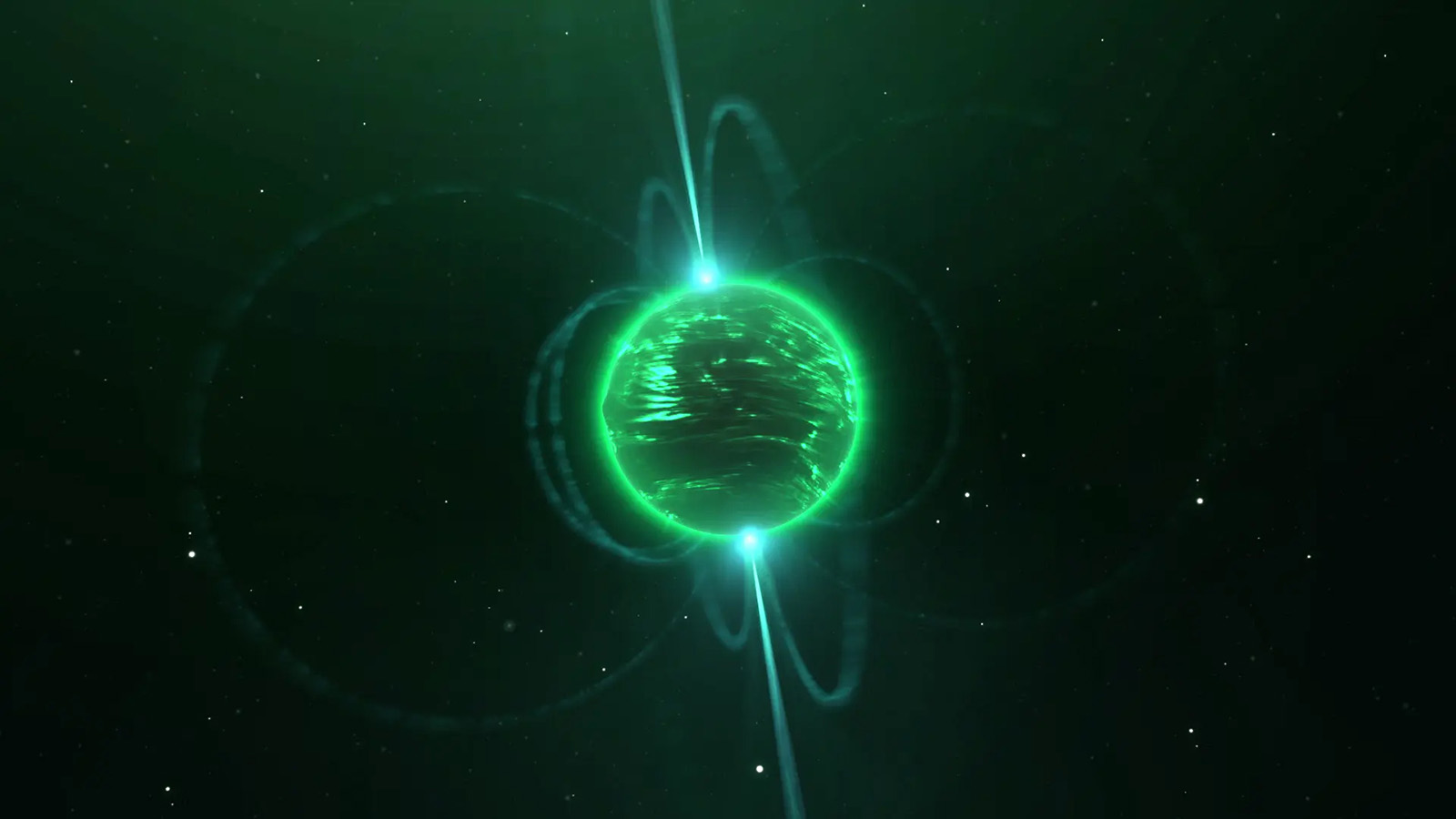
Artist’s impression of a pulsar – a rapidly rotating neutron star emitting beams of radiation. Credit: M.A. Papa/AEI/Milde Science Communication/MovieBrats Studios.

These stellar partnerships may also help solve one of astronomy’s biggest mysteries: the origin of heavy elements such as gold and uranium. Some hypotheses suggest that processes causing the ejection of matter from neutron stars in binary systems may scatter these heavy elements throughout the cosmos.

“What has slowed the discovery of pulsars in binary systems until now is that we had to characterize the companion star before studying the pulsar itself,” says Zackay. “The new, efficient method will allow us to find pulsars in binary systems blindly, without prior information about the companion, and even to learn about the companion’s properties through observations of the pulsar. Estimates suggest that hundreds of such pulsars are waiting to be discovered.”

Also participating in the study were Dr. Colin J. Clark of the Max Planck Institute for Gravitational Physics in Hannover, Germany, and Prof. Erik Agrell of Chalmers University of Technology in Gothenburg, Sweden.

Dr. Barak Zackay's research is supported by the Shimon and Golde Picker – Weizmann Annual Grant.

Fighting Cancer

From a Complex Problem to a Dizzying Discovery: A New Method for Finding Cosmic Lighthouses

A Weizmann Institute algorithm helps discover pulsars – rapidly spinning stars  that can serve as cosmic lighthouses for space navigation and natural laboratories for testing Einstein’s theory of relativity

TAGS: Algorithms , Astrophysics , Collaborations , Computers , Mathematics , Physics , Space , Technology

From A Complex Problem To A Dizzying Discovery 3
Artist’s impression of gamma-ray pulses (pink) from the newly discovered pulsar PSR J1622-7204, shown at its actual position in the sky but artificially brightened for visibility. The background map, based on 15 years of observations by NASA’s Fermi space telescope, shows gamma-ray emission across the entire sky, with the bright horizontal band marking the plane of our galaxy, the Milky Way. Credit: B. Knispel, Max Planck Institute for Gravitational Physics; NASA/DOE/Fermi LAT Collaboration.

REHOVOT, ISRAEL — November 19, 2026 — A newly discovered star in the southern sky spins at the dizzying rate of more than 260 rotations per second, sending regular pulses of energy toward Earth. Stars of this kind, known as pulsars, provide ideal environments for studying general relativity and gravitational waves, and they can even be used for space navigation. Yet finding pulsars in the vastness of the universe is such a computationally demanding task that a previous attempt to detect this particular pulsar failed despite having taken up computing time equivalent to 600 years on a single processor core. 

Now, researchers at the Weizmann Institute of Science have developed a new algorithm that has enabled them, and their collaborators at the Max Planck Institute for Gravitational Physics in Hannover, Germany, and Chalmers University of Technology in Gothenburg, Sweden, to accomplish the task in just 100 minutes. The discovery of the pulsar – named PSR J1622-7204 – is described in a paper published today in Physical Review Letters, and the new method is already being used to discover additional pulsars.

From A Complex Problem To A Dizzying Discovery 1
Dr. Barak Zackay

When stars with masses between eight and 20 times that of our Sun run out of their nuclear fuel, they collapse inward and may become pulsars – rapidly rotating, ultra-dense neutron stars. Pulsars generate magnetic fields trillions of times stronger than that of Earth. These fields accelerate charged particles and produce powerful beams of radiation. As the pulsar rotates, its beam sweeps across the sky, pointing toward Earth for only a brief instant during each rotation. As a result, it appears from Earth that the star is emitting energy in regular pulses. Because pulsars continuously lose energy throughout their lifetimes, their rotation gradually slows as they age, and the rate of their pulses decreases.

The first pulsar, discovered in 1967, emitted radio waves, as did nearly all pulsars discovered during the following four decades. In 2008, the launch of NASA’s Fermi Gamma-ray Space Telescope, which detects high-energy radiation, opened new possibilities. In its 18 years of operation, Fermi has identified almost 1,000 regions of the sky emitting gamma rays with characteristics typical of pulsars. Yet conclusively identifying a pulsar remains a complicated task. To do so, astronomers must find a combination of the exact position in the sky and rotational properties – such as rotation rate and its gradual slowdown over time – that matches the observed pulse pattern.

“Trying to find the correct combination among all possibilities without a smart strategy forces us to test an astronomical number of guesses,” explains Dr. Barak Zackay of Weizmann’s Particle Physics and Astrophysics Department. “Another challenge is that although a pulse of energy reaches Earth with every rotation of a pulsar, the Fermi telescope only manages to detect a single packet of energy – a photon – roughly once every 100 million rotations. In addition, the telescope itself is moving, orbiting Earth as Earth circles the Sun. All these factors make the computation required to find a pulsar extremely demanding.”

A geometric solution to a physics problem

In 2025, Zackay’s research group demonstrated that the search for pulsars could be radically simplified. Their approach is based on the premise that each detected pulse marks the completion of a full rotation of the pulsar and its return to the orientation in which its radiation is directed toward Earth. However, as noted, Fermi captures only a tiny fraction of the pulses, leaving unknown the number of full rotations completed between observations. If that information were available, scientists could directly calculate the star’s rotation rate and determine its other properties.

The algorithm developed by the Weizmann researchers aims to supply this missing information.

The researchers realized that each possible guess – which corresponds to a sequence of whole-number rotations – can be represented as a point in a geometric structure known as a lattice. To visualize a lattice, imagine standing at the bottom-left corner of a grid and being allowed to move only in whole-number steps upward and to the right. Every intersection on the grid represents a particular combination of upward and rightward steps – in other words, a set of integers.

"Estimates suggest that hundreds of such pulsars are waiting to be discovered.”

Scientists feed the arrival times of several dozen photons, suspected to be pulses from an unidentified pulsar, into the new algorithm. Based on these measurements, the algorithm constructs a lattice in which each point represents a hypothesis as to the number of rotations the pulsar completed between observations. Each set of rotation counts corresponds to a star with a specific rotational frequency. If the hypothesis is incorrect, calculating the number of rotations completed between observations using that frequency yields non-integer values.

The Weizmann algorithm searches for a solution that minimizes such non-integer deviations, a task known in mathematics as the shortest vector problem. The advantage of reframing the physics problem as a geometric one is that the lattice structure allows previous hypotheses to be added and subtracted, thereby rapidly generating new potential solutions. Although the problem remains computationally difficult, efficient algorithms have been developed for solving it, and the Weizmann algorithm is an adaptation of the most powerful among them.

A new lighthouse in the southern universe

Late last year, scientists from Zackay’s laboratory and from the research group of Prof. Bruce Allen at the Max Planck Institute in Hannover began applying the new method to search for pulsars in promising regions of the sky.

“We found the PSR J1622-7204 in a very short time,” says Zackay. “We ran the new algorithm 20 times, each time using a slightly different set of 80 photons that we suspected originated from the same pulsar, and one of those runs produced the right answer. Each run took just five minutes on a single CPU core, allowing us to determine the star’s properties in less than two hours. We were somewhat lucky, however, since theoretical calculations showed it should take 300 runs to achieve a 95 percent probability of success.”

From A Complex Problem To A Dizzying Discovery 2 (1)
Dotan Gazith

“We were able to calculate the pulsar’s rotation rate with great precision and determine the rate at which it slows over time,” says Dotan Gazith of Zackay’s lab, who led the study together with Dr. Daniel Pook-Kolb from Allen’s group. “Our calculations show that in about 100 million years, the star will complete roughly five fewer rotations per second than it does today. We have since expanded the search, and we are already discovering additional pulsars using this new method.”

Pulsars are sometimes referred to as lighthouses of the universe. A NASA experiment conducted in 2018 showed that a spacecraft can determine its position in space to within a few kilometers by measuring the arrival times of pulses from different pulsars. The discovery of extremely fast pulsars – those that rotate hundreds of times per second – is particularly important because they can serve as the basis for extraordinarily precise clocks. Research groups around the world are working to develop such clocks not only for navigation, but also because deviations in their timing could reveal effects predicted by Einstein’s general theory of relativity, formulated more than a century ago.

The central principle of general relativity is that the universe has four dimensions – length, width, height and time – and that massive objects warp the spacetime around them. Like a stone thrown into a lake, accelerating masses generate ripples in spacetime – known as gravitational waves – which propagate throughout the universe. When a gravitational wave passes through Earth and distorts our local spacetime, the arrival times of pulses from the various pulsars should accordingly deviate slightly from their expected values. In order to detect such deviations, caused by low-frequency gravitational waves, an international effort is currently underway to systematically make ultra-precise measurements of the pulse arrival times from a network of exceptionally stable pulsars. Although high-frequency gravitational waves were already detected by other methods in 2015, theory predicts the existence of many low-frequency gravitational waves that require different methods to be observed. These observations may uncover dramatic events such as the mergers of super massive black holes, each with a mass a billion times greater than that of the Sun.

A distorted relationship

The newly discovered pulsar is a loner, but many of the fastest known pulsars are part of a cosmic partnership. In such binary systems, a pulsar and a companion star orbit a common center of mass, thereby serving as outstanding laboratories for testing the laws of general relativity.

Because the companion star curves the spacetime around it, the pulsar’s signals must travel through a distorted cosmic landscape. As a result, scientists on Earth may observe a slight delay in the arrival of the pulsar’s signals. Measuring that delay can reveal key properties of the companion, including its mass. This is only one example of the many relativistic effects that can be studied in such systems.

From A Complex Problem To A Dizzying Discovery 4
Artist’s impression of a pulsar – a rapidly rotating neutron star emitting beams of radiation. Credit: M.A. Papa/AEI/Milde Science Communication/MovieBrats Studios.

These stellar partnerships may also help solve one of astronomy’s biggest mysteries: the origin of heavy elements such as gold and uranium. Some hypotheses suggest that processes causing the ejection of matter from neutron stars in binary systems may scatter these heavy elements throughout the cosmos.

“What has slowed the discovery of pulsars in binary systems until now is that we had to characterize the companion star before studying the pulsar itself,” says Zackay. “The new, efficient method will allow us to find pulsars in binary systems blindly, without prior information about the companion, and even to learn about the companion’s properties through observations of the pulsar. Estimates suggest that hundreds of such pulsars are waiting to be discovered.”

Also participating in the study were Dr. Colin J. Clark of the Max Planck Institute for Gravitational Physics in Hannover, Germany, and Prof. Erik Agrell of Chalmers University of Technology in Gothenburg, Sweden.

Dr. Barak Zackay's research is supported by the Shimon and Golde Picker – Weizmann Annual Grant.