
Exploring the Physical World

The Moon’s Dark Secret: Shadowed Cold Traps Could Unlock the Mystery of Lunar Ice

New evidence suggests that ice has been accumulating on the Moon for 1.5 billion years –
and reveals the most promising places to find it

The Moons Dark Secret
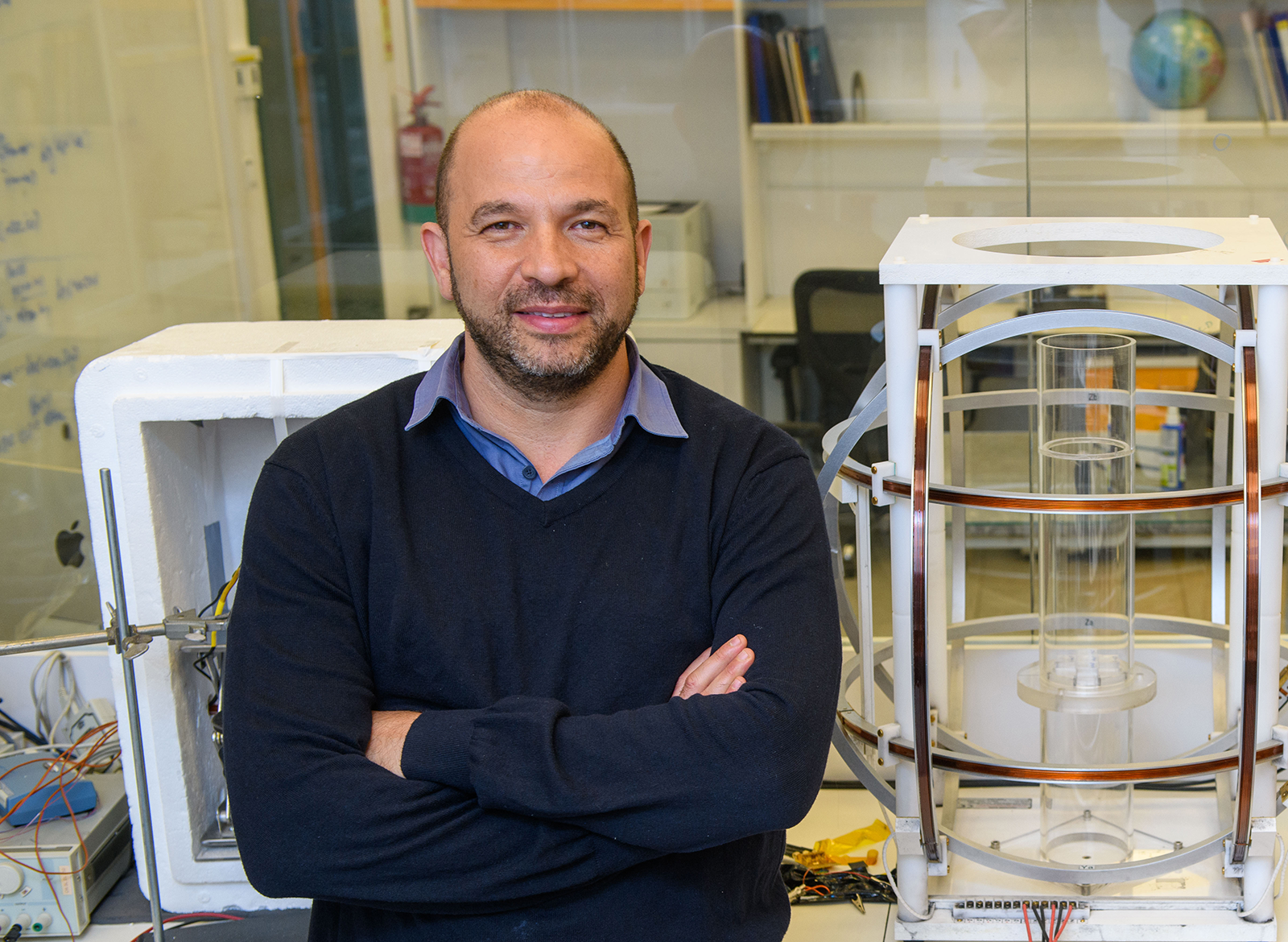
Prof. Oded Aharonson

REHOVOT, ISRAEL — April 7, 2026 — More than half a century after the last crewed landing, a new lunar space race is underway – with last week’s launching of NASA’s Artemis II mission and the United States, Russia, and China all aiming to establish permanent bases on the Moon. Unlike the Apollo program, during which American astronauts landed at six different sites on the lunar surface, 21st-century missions are all focused on a single location: the Moon’s South Pole. Spaceflight pioneer Robert H. Goddard proposed over a century ago that ice deposits might exist at the lunar poles, and indirect evidence collected over the past 20 years has lent support to this hypothesis. In space exploration, ice is a highly sought-after resource: It can be processed into water for drinking and irrigation, split into rocket fuel for deep-space travel, and even used to study the history of celestial bodies. 

Now, researchers from the Weizmann Institute of Science, together with collaborators in the United States, have uncovered new scientific evidence showing that ice has been gradually accumulating on the Moon’s poles for at least 1.5 billion years. Their new study, published today in Nature Astronomy, identifies ancient “cold traps” on the lunar surface and designates them as prime targets for future missions.

Unlike Earth, whose tilted axis causes the Sun’s position in the sky to change throughout the year, the Moon has almost no tilt, and the Sun is always positioned approximately above its equator. If you were standing at one of the lunar poles, you would see the Sun staying close to the horizon as it completes a monthly cycle rather than rising and setting as it does on Earth. As a result, sunlight cannot reach and warm the deep, steep craters at the lunar poles, which are known as “permanently shadowed regions.”

This was not always the case. In the distant past, the Moon had a much greater axial tilt, but over the last several billion years it has been straightening up. In 2023, researchers showed that as the Moon’s tilt decreased, more and more craters near the poles became permanently shadowed, and cooled dramatically. By calculating when each crater lost its exposure to sunlight, they were able to deduce the “age” of each permanently shadowed region.

“Finding water beyond Earth in liquid and usable form is one of the most important challenges in astronomy."

In the new study, Prof. Oded Aharonson of Weizmann’s Earth and Planetary Sciences Department and his collaborators – Prof. Paul Hayne of the University of Colorado Boulder and Dr. Norbert Schörghofer of the Planetary Science Institute in Honolulu – set out to examine whether there is a connection between the age of a permanently shadowed region and the proportion of its area covered by ice.

Ice reflects more ultraviolet light at certain wavelengths than the Moon’s rocky surface, making it possible to infer where it is located. Ultraviolet light provides an advantage because it emanates not only from the Sun but also from distant stars, and it can enter permanently shadowed areas. The researchers analyzed data collected by an ultraviolet-sensitive instrument aboard NASA’s Lunar Reconnaissance Orbiter, which has been orbiting and mapping the Moon since 2009.

“We found that the earlier a region became shadowed, the larger the area that was able to accumulate ice,” says Aharonson. “This trend began at least 1.5 billion years ago and has continued even over the past 100 million years. This suggests that ice has been building up on the Moon from a nearly continuous source – or sources – rather than through a single event such as a large comet impact.”

For ice not only to form on the lunar surface but also to persist for hundreds of millions or even billions of years without evaporating, extremely low temperatures are required – around minus 160 degrees Celsius. Regions that maintain such temperatures year-round are known as cold traps. While many permanently shadowed regions qualify as cold traps, some do not, because surrounding walls can radiate heat into the crater.

To identify the most promising locations for finding lunar ice, the researchers used geometric calculations to determine which permanently shadowed regions also function as cold traps, and when in the Moon’s history they acquired this status.

A 3-D animation showing permanently shadowed craters (white and light blue) near the Moon’s South Pole (black arrow), considered promising locations for finding water ice. Scientists have discovered evidence that these cold traps have been accumulating water ice (violet) for at least 1.5 billion years – but not all are equally effective. The well-known Shackleton Crater (closest to the South Pole) has been too warm for much of lunar history to collect ice. In contrast, Haworth Crater (the one with the greatest expected ice coverage) has acted as an efficient ice trap for billions of years – and was therefore identified as a prime target for future landed missions. The animation is based on data from the Lunar Orbiter Laser Altimeter and the Lyman-Alpha Mapping Project on board NASA's Lunar Reconnaissance Orbiter.

“The longer a given region has been a cold trap, the more ice it has accumulated,” Aharonson explains. “In most cases, a crater became shadowed and turned into a cold trap at the same time – but not always. For example, Shackleton Crater has been shadowed for about 3.5 billion years and was considered a promising site in the search for lunar ice. We discovered, however, that it only became a cold trap around 500 million years ago. To identify targets for future missions, we searched for the oldest cold traps and found several extensive ones more than 3.3 billion years old near the Moon’s South Pole.”

These findings are especially significant since locating and sampling lunar ice is one of the primary goals of NASA’s future crewed Artemis missions, scheduled to land astronauts at the Moon’s South Pole. NASA’s long-term vision includes establishing a permanent lunar base to serve as preparation – and possibly a transit station – for future crewed missions to Mars.

“The gold-standard proof of the existence of ice on the Moon would be a sample of it,” says Aharonson. “It would allow us to compare the chemical composition of water on the Moon with that on Earth, and to assess whether – and how – crewed lunar missions could make use of this resource.”

The study supplies motivation for follow-up exploration of the most ancient cold traps and provides guidance on the best locations to target, such as Haworth Crater, one of the newly identified ancient cold traps. “Future spacecraft missions would be able to collect extensive data on the ice from the crater’s surface, and rovers would be able to approach, enter and sample the ice deposits,” says Hayne. 

The origins of lunar ice

Although the origin of lunar water remains unresolved, the researchers built a simple mathematical model to explore various possibilities. According to the model, the amount of ice on the Moon’s surface is affected by three processes: water supply, evaporation, and what’s known as impact gardening – a process in which the disturbance of lunar soil and rocks redistributes ice and buries it beneath the surface.

The observation that relatively little ice is found in younger cold traps, combined with the slow accumulation of ice over hundreds of millions of years, led the researchers to conclude that both water supply and water loss on the Moon occur at relatively rapid rates, like a faucet filling a leaking bucket.

One proposed source of lunar water is that volatile water from the Moon’s interior reaches the surface through volcanic activity. Another possible source is solar wind: a stream of hydrogen atoms capable of taking part in chemical reactions on the lunar surface to form water. A third option is asteroid and comet impacts – not a single catastrophic event, but multiple impacts occurring every few million years.

“Finding water beyond Earth in liquid and usable form is one of the most important challenges in astronomy,” Aharonson says. “Planned lunar missions may help us determine the origin of water on the Moon – but they could also teach us much more. As Earth’s natural satellite, the Moon is an excellent laboratory for studying the history of our planet and its water. Moreover, we may gain insights into the composition and distribution of water that could be waiting for us on more distant planets and moons we have yet to visit.”

Prof. Oded Aharonson is head of the Dr. Scholl Foundation Center for Water and Climate Research and of the Sussman Family Center for the Study of Environmental Sciences. The Stephen and Claire Reich Research Fellow Chair in Chemistry supports a staff scientist in Prof. Aharonson’s lab.


Exploring the Physical World

The Moon’s Dark Secret: Shadowed Cold Traps Could Unlock the Mystery of Lunar Ice

New evidence suggests that ice has been accumulating on the Moon for 1.5 billion years –
and reveals the most promising places to find it

TAGS: Astrophysics , Climate studies , Collaborations , Environment , Evolution , Physics , Space , Water

The Moons Dark Secret
Prof. Oded Aharonson

REHOVOT, ISRAEL — April 7, 2026 — More than half a century after the last crewed landing, a new lunar space race is underway – with last week’s launching of NASA’s Artemis II mission and the United States, Russia, and China all aiming to establish permanent bases on the Moon. Unlike the Apollo program, during which American astronauts landed at six different sites on the lunar surface, 21st-century missions are all focused on a single location: the Moon’s South Pole. Spaceflight pioneer Robert H. Goddard proposed over a century ago that ice deposits might exist at the lunar poles, and indirect evidence collected over the past 20 years has lent support to this hypothesis. In space exploration, ice is a highly sought-after resource: It can be processed into water for drinking and irrigation, split into rocket fuel for deep-space travel, and even used to study the history of celestial bodies. 

Now, researchers from the Weizmann Institute of Science, together with collaborators in the United States, have uncovered new scientific evidence showing that ice has been gradually accumulating on the Moon’s poles for at least 1.5 billion years. Their new study, published today in Nature Astronomy, identifies ancient “cold traps” on the lunar surface and designates them as prime targets for future missions.

Unlike Earth, whose tilted axis causes the Sun’s position in the sky to change throughout the year, the Moon has almost no tilt, and the Sun is always positioned approximately above its equator. If you were standing at one of the lunar poles, you would see the Sun staying close to the horizon as it completes a monthly cycle rather than rising and setting as it does on Earth. As a result, sunlight cannot reach and warm the deep, steep craters at the lunar poles, which are known as “permanently shadowed regions.”

This was not always the case. In the distant past, the Moon had a much greater axial tilt, but over the last several billion years it has been straightening up. In 2023, researchers showed that as the Moon’s tilt decreased, more and more craters near the poles became permanently shadowed, and cooled dramatically. By calculating when each crater lost its exposure to sunlight, they were able to deduce the “age” of each permanently shadowed region.

“Finding water beyond Earth in liquid and usable form is one of the most important challenges in astronomy."

In the new study, Prof. Oded Aharonson of Weizmann’s Earth and Planetary Sciences Department and his collaborators – Prof. Paul Hayne of the University of Colorado Boulder and Dr. Norbert Schörghofer of the Planetary Science Institute in Honolulu – set out to examine whether there is a connection between the age of a permanently shadowed region and the proportion of its area covered by ice.

Ice reflects more ultraviolet light at certain wavelengths than the Moon’s rocky surface, making it possible to infer where it is located. Ultraviolet light provides an advantage because it emanates not only from the Sun but also from distant stars, and it can enter permanently shadowed areas. The researchers analyzed data collected by an ultraviolet-sensitive instrument aboard NASA’s Lunar Reconnaissance Orbiter, which has been orbiting and mapping the Moon since 2009.

“We found that the earlier a region became shadowed, the larger the area that was able to accumulate ice,” says Aharonson. “This trend began at least 1.5 billion years ago and has continued even over the past 100 million years. This suggests that ice has been building up on the Moon from a nearly continuous source – or sources – rather than through a single event such as a large comet impact.”

For ice not only to form on the lunar surface but also to persist for hundreds of millions or even billions of years without evaporating, extremely low temperatures are required – around minus 160 degrees Celsius. Regions that maintain such temperatures year-round are known as cold traps. While many permanently shadowed regions qualify as cold traps, some do not, because surrounding walls can radiate heat into the crater.

To identify the most promising locations for finding lunar ice, the researchers used geometric calculations to determine which permanently shadowed regions also function as cold traps, and when in the Moon’s history they acquired this status.

A 3-D animation showing permanently shadowed craters (white and light blue) near the Moon’s South Pole (black arrow), considered promising locations for finding water ice. Scientists have discovered evidence that these cold traps have been accumulating water ice (violet) for at least 1.5 billion years – but not all are equally effective. The well-known Shackleton Crater (closest to the South Pole) has been too warm for much of lunar history to collect ice. In contrast, Haworth Crater (the one with the greatest expected ice coverage) has acted as an efficient ice trap for billions of years – and was therefore identified as a prime target for future landed missions. The animation is based on data from the Lunar Orbiter Laser Altimeter and the Lyman-Alpha Mapping Project on board NASA's Lunar Reconnaissance Orbiter.

“The longer a given region has been a cold trap, the more ice it has accumulated,” Aharonson explains. “In most cases, a crater became shadowed and turned into a cold trap at the same time – but not always. For example, Shackleton Crater has been shadowed for about 3.5 billion years and was considered a promising site in the search for lunar ice. We discovered, however, that it only became a cold trap around 500 million years ago. To identify targets for future missions, we searched for the oldest cold traps and found several extensive ones more than 3.3 billion years old near the Moon’s South Pole.”

These findings are especially significant since locating and sampling lunar ice is one of the primary goals of NASA’s future crewed Artemis missions, scheduled to land astronauts at the Moon’s South Pole. NASA’s long-term vision includes establishing a permanent lunar base to serve as preparation – and possibly a transit station – for future crewed missions to Mars.

“The gold-standard proof of the existence of ice on the Moon would be a sample of it,” says Aharonson. “It would allow us to compare the chemical composition of water on the Moon with that on Earth, and to assess whether – and how – crewed lunar missions could make use of this resource.”

The study supplies motivation for follow-up exploration of the most ancient cold traps and provides guidance on the best locations to target, such as Haworth Crater, one of the newly identified ancient cold traps. “Future spacecraft missions would be able to collect extensive data on the ice from the crater’s surface, and rovers would be able to approach, enter and sample the ice deposits,” says Hayne. 

The origins of lunar ice

Although the origin of lunar water remains unresolved, the researchers built a simple mathematical model to explore various possibilities. According to the model, the amount of ice on the Moon’s surface is affected by three processes: water supply, evaporation, and what’s known as impact gardening – a process in which the disturbance of lunar soil and rocks redistributes ice and buries it beneath the surface.

The observation that relatively little ice is found in younger cold traps, combined with the slow accumulation of ice over hundreds of millions of years, led the researchers to conclude that both water supply and water loss on the Moon occur at relatively rapid rates, like a faucet filling a leaking bucket.

One proposed source of lunar water is that volatile water from the Moon’s interior reaches the surface through volcanic activity. Another possible source is solar wind: a stream of hydrogen atoms capable of taking part in chemical reactions on the lunar surface to form water. A third option is asteroid and comet impacts – not a single catastrophic event, but multiple impacts occurring every few million years.

“Finding water beyond Earth in liquid and usable form is one of the most important challenges in astronomy,” Aharonson says. “Planned lunar missions may help us determine the origin of water on the Moon – but they could also teach us much more. As Earth’s natural satellite, the Moon is an excellent laboratory for studying the history of our planet and its water. Moreover, we may gain insights into the composition and distribution of water that could be waiting for us on more distant planets and moons we have yet to visit.”

Prof. Oded Aharonson is head of the Dr. Scholl Foundation Center for Water and Climate Research and of the Sussman Family Center for the Study of Environmental Sciences. The Stephen and Claire Reich Research Fellow Chair in Chemistry supports a staff scientist in Prof. Aharonson’s lab.