

REHOVOT, ISRAEL — February 2, 2026 — For over 50 years, we thought we knew the size and shape of Jupiter, the solar system’s largest planet. Now, Weizmann Institute of Science researchers have revised that knowledge using new data and technology.
In a new study published today in Nature Astronomy, Weizmann scientists, who led an international team from Italy, the US, France, and Switzerland, provide the most precise determination yet of Jupiter’s size and shape.
“Just by knowing the distance to Jupiter and watching how it rotates, it’s possible to figure out its size and shape,” says Prof. Yohai Kaspi of Weizmann’s Earth and Planetary Sciences Department. “But making really accurate measurements calls for more sophisticated methods.”
“Jupiter’s shape, as understood until now, was derived by researchers from just six measurements made almost five decades ago by NASA’s Voyager and Pioneer missions, which sent radio beams from the spacecraft to Earth,” explains Dr. Eli Galanti, a senior staff scientist who led the research in Kaspi’s team. “Those missions provided a foundation, but now we got the rare opportunity to spearhead the analysis of as many as 26 new measurements made by NASA’s Juno spacecraft.”
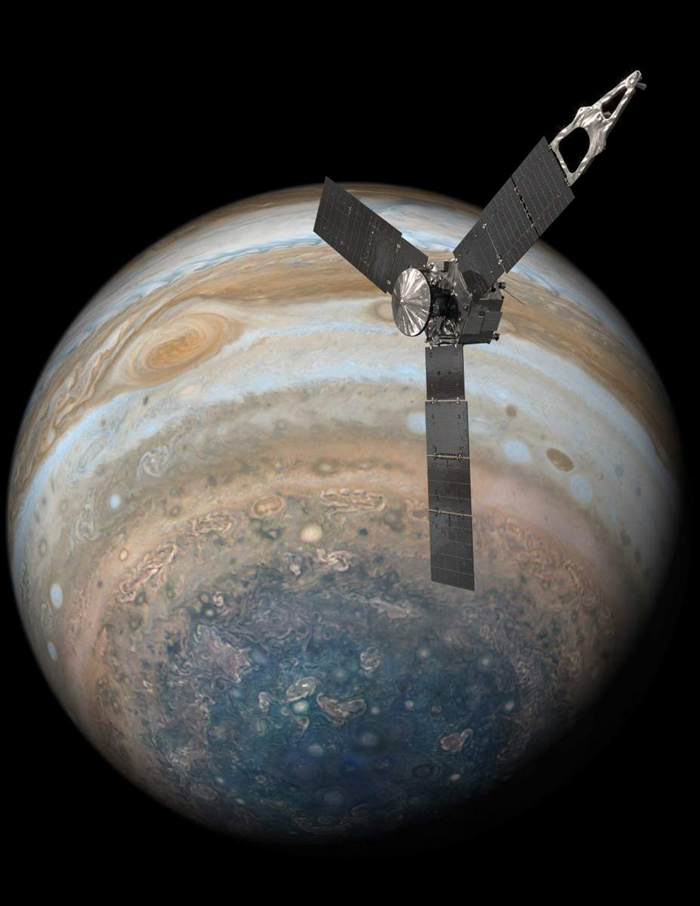
Launched in 2011 and orbiting Jupiter since 2016, Juno has been sending back to NASA streams of raw data. When NASA extended the mission in 2021 so the spacecraft could keep studying Jupiter and its moons more closely, Juno’s new expanded path placed the spacecraft in an orbit that allowed it to pass behind Jupiter from Earth’s point of view, something its earlier orbit never did. “Juno’s passing behind Jupiter provides an opportunity for new science objectives. When the spacecraft passes behind the planet, its radio communication signal is blocked and bent by Jupiter’s atmosphere. This enables an accurate measurement of Jupiter’s size,” says Juno’s Principal Investigator Dr. Scott J. Bolton of Southwest Research Institute in San Antonio, Texas.
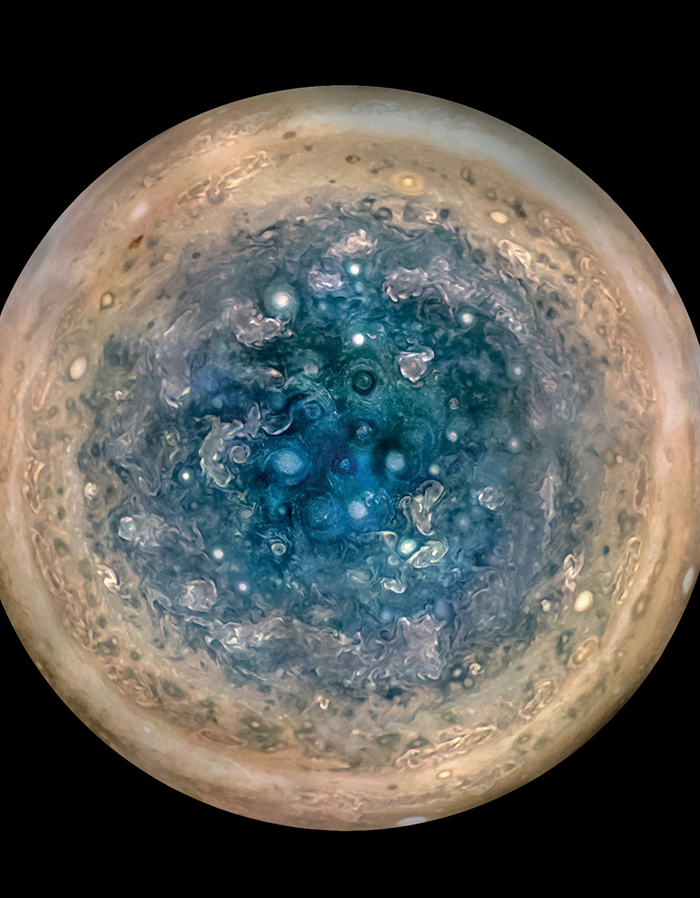
The Juno team at Weizmann seized this new opportunity. “We tracked how the radio signals bend as they pass through Jupiter’s atmosphere, which allowed us to translate this information into detailed maps of Jupiter’s temperature and density, producing the clearest picture yet of the giant planet’s size and shape,” says Maria Smirnova, a PhD student in Kaspi’s group, who developed a special technique to process Juno’s new data.
“This research helps us understand how planets form and evolve,” Kaspi says. “Jupiter was likely the first planet to form in the solar system, and by studying what’s happening inside it, we get closer to understanding how the solar system, and planets like ours, came to be.”
The new findings show that Jupiter is slightly smaller than previously estimated – it’s about 8 km less wide at the equator and 24 km flatter at the poles. In other words, it’s more flattened compared to previous assessments. “Textbooks will need to be updated,” Kaspi says. “The size of Jupiter hasn’t changed, of course, but the way we measure it has.”
“These few kilometers matter,” Galanti explains. “Shifting the radius by just a little lets our models of Jupiter’s interior fit both the gravity data and atmospheric measurements much better.” This implication was tested by another PhD student in Kapsi’s group, Maayan Ziv. “We were in a unique position to use our state-of-the-art models for the interior density structure of Jupiter to show that the refined shape helps bridge the gap between the models and the measurements,” Ziv says. This study also has broader implications for understanding the structure of gas planets in general, since Jupiter serves as a standard reference for the study of gas giants within the solar system and beyond.
Kaspi notes also that earlier measurements didn’t account for Jupiter’s powerful winds. By including these extreme winds in their calculations, the Weizmann team cleared up long-standing discrepancies in earlier measurements. “It’s difficult to see what’s happening beneath the clouds of Jupiter, but the radio data give us a window into the depth of Jupiter’s zonal winds and powerful hurricanes,” Kaspi explains.
The work on the winds ties into a recent study by Kaspi and Dr. Nimrod Gavriel, a graduate of Kaspi’s group, on Jupiter’s vast polar cyclones. That study, published in PNAS, used Juno measurements of these cyclones’ motion to predict how deep into the interior they extend. Overall, an improved understanding of Jupiter’s winds enables scientists to elucidate the relation between the planet’s atmosphere and its deep interior. Their prediction was recently confirmed by microwave measurements made by the Juno spacecraft.
“This research helps us understand how planets form and evolve,” Kaspi says. “Jupiter was likely the first planet to form in the solar system, and by studying what’s happening inside it, we get closer to understanding how the solar system, and planets like ours, came to be.”
Looking into the future, the techniques developed in these studies will serve the team during their analysis of data from the European Space Agency’s unmanned spacecraft JUICE, launched in 2023. The mission carries a Weizmann-designed instrument that will allow a deeper view into the planet’s atmosphere.
Also participating in the study were Matteo Fonsetti, Andrea Caruso, Paolo Tortora, and Marco Zannoni from the University of Bologna, Italy; Dustin R. Buccino, Steven M. Levin, Marzia Parisi, and Ryan S. Park from the Jet Propulsion Laboratory, California Institute of Technology, USA; William B. Hubbard from the University of Arizona, USA; Burkhard Militzer from the University of California, Berkeley, USA; Tristan Guillot from the Observatoire de la Côte d’Azur, France; Ravit Helled from the University of Zürich, Switzerland; Paul Steffes from the Georgia Institute of Technology, USA; and Paul Withers from Boston University, USA.
Prof. Yohai Kaspi’s research is supported by the Helen Kimmel Center for Planetary Science; the Knell Family Institute of Artificial Intelligence; and the Brenden-Mann Women’s Innovation Impact Fund.
The Juno mission is managed by NASA's Jet Propulsion Laboratory, a division of Caltech in Pasadena, California, for the agency's Science Mission Directorate in Washington, D.C. For more information about the Juno mission, visit NASA’s Juno spacecraft and Mission Juno.